Japanese Masks: A Complete Guide to Types, History, and Meaning
Walk into any Japanese antique market, matsuri street stall, or traditional theater, and you will find them watching you: hollow eyes that somehow hold more expression than any human face. Japanese masks are not costumes. They are transformation objects — worn to become something other than yourself, whether a jealous spirit, a divine fox, a demon from the edge of the world, or a god older than memory.
This guide covers the major mask traditions of Japan: where they came from, what they mean, and why they continue to captivate audiences far beyond the country that made them.
Quick reference: the five mask types at a glance
| Mask | What it depicts | Where you meet it | How to recognise it |
|---|---|---|---|
| Noh | Characters of noh theatre | Noh stage | Carved cypress, painted in gofun; expression shifts with the tilt of the head |
| Hannya | A woman transformed by jealousy and grief | Noh theatre | Two horns, split mouth, brows arched in anguish |
| Tengu | Mountain spirits | Noh plays and shrine festivals | Long human nose (daitengu) or a bird beak (karasu-tengu) |
| Oni | Demons | Setsubun in early February | Horns and fangs; red for greed, blue for anger |
| Kitsune | The fox, messenger of Inari | Inari shrines and festivals | Fox muzzle, often white with red markings |
A Brief History of Japanese Masks

Photo: 国立文化財機構, CC BY 4.0, via Wikimedia Commons
Masks arrived in Japan as part of a wave of continental culture. The earliest documented tradition is gigaku (伎楽), a masked processional theater introduced from the Korean kingdom of Baekje around 612 CE by a performer named Mimashi. Gigaku masks were large, covering the entire head rather than just the face, and depicted a vivid cast of characters — Buddhist guardian figures, exaggerated foreigners, a drunken king, a lion. The performances were held at major Buddhist temples: records confirm gigaku was performed at Tōdai-ji for the eye-opening ceremony of the Great Buddha in 752 CE, and masks attributed to Hōryū-ji date to the seventh century. Gigaku flourished in the Nara period (710–794), declined during the Heian period as court tastes shifted, and had disappeared entirely by the Kamakura period. Over two hundred gigaku masks survive today in temple and national museum collections, making them among the oldest performance masks in the world.
As gigaku faded, bugaku (舞楽) took its place at the imperial court. A form of masked dance performed alongside gagaku court music, bugaku blended Chinese, Korean, Indian, and Southeast Asian dance traditions into a distinctly Japanese form. It has been performed continuously for over twelve hundred years. Today the Imperial Household Agency maintains the tradition, and bugaku performances remain part of state ceremonies and major shrine festivals.
The fourteenth century saw the emergence of the tradition that would define Japanese mask-making: noh theater. Developed and codified by Zeami Motokiyo (c.1363–c.1443) from older forms of sarugaku, noh uses carved wooden masks to represent women, elderly figures, gods, spirits, and demons. There are approximately 60 basic mask types in the noh repertoire, with around 250 varieties when sub-types and regional traditions are included. These 60 types are enough to stage virtually all 240 plays in the current active repertoire.
Alongside noh, kyogen (狂言) — the comic interlude plays performed between noh pieces — developed its own mask tradition. Kyogen masks depict humans more than spirits: bumbling servants, shrewish wives, oblivious old men. They are broader, more exaggerated, and often deliberately absurd.
Festival and folk masks form a third tradition running parallel to theatrical masking. These include the oni (demon) masks of Setsubun, the kitsune (fox) masks of Inari shrine festivals, the hyottoko and okame (お多福) masks of Bon Odori celebrations, and the frightening namahage figures of Akita Prefecture, who visit homes on New Year's Eve to drive away laziness and evil.
The Major Mask Types
Noh Masks

Photo: Daderot, CC0, via Wikimedia Commons
Noh masks are carved from cypress wood (hinoki), painted in layers of gofun (powdered shell) mixed with animal glue, and finished with mineral pigments. The carving process can take weeks or months, and the great mask lineages guarded their techniques as family secrets across generations.
A noh mask is designed to express multiple emotions simultaneously. The slight upward tilt of the mask toward stage lighting (terasu, to brighten the expression) or downward tilt (kumorasu, to shadow it) shifts the apparent emotion entirely, allowing a single carved face to convey joy, grief, or cold fury depending on the angle. This quality is especially visible in masks such as ko-omote (a young woman), deigan (a semi-divine female face), and shunkan (a gaunt, exiled monk).
The categories of noh masks include:
- Old man (jō) masks: The most sacred, including okina, used in the ancient ritual piece Okina that predates noh itself. Okina's jaw is carved separately and attached with a cord (kiri-ago, 切り顎), allowing the actor to chant while masked — a unique structural feature found nowhere else in noh.
- Female masks: Ko-omote (young woman), zō-onna (mature woman), rōjo (elderly woman), and the demon-women such as hannya and deigan.
- Male masks: Chūjō (noble man), yase-otoko (emaciated spirit), imawaka (young man).
- Spirit and god masks: Tobide (fierce deity), shiwa-jō (white-bearded god), ayakashi (sea spirit).
- Demon masks: Shikami (fanged demon), beshimi (tight-lipped demon), and the full range of oni expressions.
→ Read the full guide: Noh Masks: The Silence That Speaks
Hannya

Photo: ColBase: Integrated Collections Database of the National Museums, Japan: online database: entry tnm/C-1554, CC BY 4.0, via Wikimedia Commons
The hannya is noh theater's most iconic mask: a woman consumed by jealousy and grief until she has transformed into something no longer entirely human. The face splits open at the corners of the mouth, the brows arch upward in permanent anguish, and two horns protrude from the forehead. It is not simply a demon mask — it is a portrait of a specific psychological state.
Three levels of hannya correspond to the depth of the transformation: shiro-hannya (white, still recognizably human, sorrow dominant), aka-hannya (red, full transformation, rage dominant), and kuro-hannya (black, used in the play Kurozuka for the most terrifying, fully non-human form). Each level is a distinct mask.
→ Read the full guide: The Hannya Mask: Jealousy, Sorrow, and the Most Misread Face in Japanese Art
Tengu

Photo: Image: http://collections.lacma.org/sites/default/files/remote_images/piction/ma-31778885-O3.jpg Gallery: http://collections.lacma.org/node/192453 archive copy , Public domain, via Wikimedia Commons
The tengu (天狗) are mountain spirits associated with martial arts mastery and supernatural power. In mask traditions, two distinct types appear. The daitengu (大天狗) is depicted with a long, prominent human nose. The karasu-tengu (烏天狗, "crow tengu") has a bird beak in place of a human nose and is considered the older, more primordial form — the original tengu image from earlier Japanese tradition, before the long-nosed type became the more widely recognized icon. Tengu masks appear in noh plays, shrine festivals, and folk celebrations across Japan's mountain regions.
Oni

Photo: Daderot, CC0, via Wikimedia Commons
The oni (鬼) is Japan's demon, and its face is among the most recognizable in the country's visual culture. Oni masks feature wild eyes, fanged mouths, and horns. Color carries specific Buddhist meaning: red oni correspond to ton'yoku (貪欲, greed), blue oni to shin'i (瞋恚, anger) — classifications drawn from the five hindrances (gogai, 五蓋) in Buddhist teaching.
Oni masks are most associated with Setsubun (節分), the bean-throwing festival held in early February to drive out demons and welcome good fortune. The earliest documented records of bean-throwing at Setsubun date to 1425, appearing in court and shogunate diaries. The famous chant "Oni wa soto! Fuku wa uchi!" (Demons out! Fortune in!) is recorded from 1447.
→ Read the full guide: The Oni Mask: Guardian, Demon, and the Face of Fear in Japanese Culture
Kitsune

Fox masks represent the kitsune (狐), Japan's most celebrated supernatural animal. The fox's association with Inari — the deity of rice, agriculture, and prosperity — developed through the Heian period, with foxes gradually becoming understood as Inari's messengers and earthly manifestations. Today approximately 30,000 Inari shrines exist across Japan, more than any other shrine type, and white fox statues guard nearly every one.
Kitsune masks range from delicate, painted fox faces used in sacred shrine dance to bold graphic designs worn at summer festivals. Their pale gold and white coloring, pointed ears, and sharply angular features are immediately identifiable across centuries of artistic tradition.
→ Read the full guide: The Kitsune Mask: History, Meaning, and the Art of the Japanese Fox
Materials and Craft

Photo: 国立文化財機構, CC BY 4.0, via Wikimedia Commons
The masks that survive from Japanese history survived for a reason: they were made of materials that last. Wood, iron, fired ceramic, lacquered paper — objects made from these endure for centuries in the right conditions. What this means, and what is easy to overlook, is that the mask traditions most visible to us today are precisely those whose materials happened to outlast their makers. An equally rich set of mask cultures made from straw, bamboo, green leaves, unglazed clay, or other perishable organic materials was produced, used, and destroyed — annually, ritually, deliberately — and left almost no physical trace.
The history of Japanese masks is, in part, a history of what did not survive.
What Survives: Durable Materials
The dominant tradition in Japanese performance masking is carved wood. Noh, kyogen, and bugaku masks are made from hinoki (Japanese cypress), chosen for its fine, stable grain, light weight, and resistance to cracking. The carver works from a block, hollowing the interior first to establish the curve that will sit against the actor's face, then shaping the exterior features with chisels and gouges in a process that can take weeks or months for a single piece.
The painted surface is built up through a separate process: multiple layers of gofun (胡粉, powdered clamshell mixed with animal glue) are applied, dried, and sanded between coats. Color comes from mineral pigments — iron oxide for skin tones, carbon black for brows and outlines, gold leaf and gold paint for the eyes of supernatural beings. The finished surface on a well-made noh mask has a depth that no single layer could produce: you are seeing through several translucent strata at once.
Japan also developed a separate tradition of facial armor. The menpo (面頬) — the face guard worn with samurai armor — survives in significant numbers because iron and lacquered leather are durable, and because armor was stored, inherited, and treasured rather than worn out. Menpo were made primarily in iron (鉄面), though lacquered-leather versions also existed. Both were finished with black or red urushi lacquer. The facial features forged into a menpo — furrowed brows, bared teeth, exaggerated mustaches — drew directly on the visual language of oni and tengu masks from the performing arts. The boundary between the two traditions was more permeable than it might appear: a samurai going into battle in a red-lacquered iron face with fanged teeth was borrowing the demon tradition for functional purposes.
A related technique in the folk and festival tradition is habutae-bari (羽二重張り), in which thin layers are built up over a mold and finished by hand. The result is smoother and lighter than ordinary papier-mâché. A habutae-bari mask is lighter and less expensive than carved wood, appropriate for festival use — and durable enough, if stored carefully, to last for generations.
The broader hariko (張り子) papier-mâché tradition uses washi glued in layers over a wood, clay, or plaster mold, dried, separated from the mold, and painted with gofun and pigment. Hariko has been used since at least the Edo period to produce folk toys, festival figures, and affordable masks. Regional workshops still produce hariko oni, fox, and character masks using molds that have been in continuous use for generations.
What Did Not Survive: Perishable Mask Traditions
Parallel to the durable-material traditions ran a vast and largely invisible world of masks made to be destroyed. Across Japanese folk religion and agricultural ceremony, masks were constructed from whatever the season and the local environment provided — rice straw, bamboo, wisteria vine, leaves, mud, gourd shells — used once for a specific ritual purpose, and then burned, buried, cast into water, or simply left to decompose. Their impermanence was the point.
In Shinto practice, many festival masks are understood not as objects to be preserved but as temporary vessels: a form given to a deity or spirit for the duration of a ceremony, then released. To preserve such a mask after the ceremony would be to trap what it was meant to free. The mask is made, the spirit enters, the ceremony is performed, the mask is gone. This logic is the opposite of the noh tradition, where a mask is stored with reverence and considered the property of the actor or the school for generations.
Among the traditions involving annually renewed masks: certain regional kagura performances commission fresh masks each year, with the previous year's masks ceremonially burned or buried at the shrine. The Oni-jo demon-expelling rites practiced in parts of Nara and Osaka feature masks assembled from plant materials that are ritually disposed of after the night's ceremony. Harvest festival traditions across Tohoku, Kyushu, and the Ryukyu islands incorporate face coverings made from local flora — some recognizable as "masks" in the conventional sense, others closer to total-body transformations using leaves, bark, and rope — that exist for one festival and are then released.
What survives of these perishable traditions is not the objects but the practices: the choreography, the chants, the timing tied to the agricultural calendar, the community roles. And since the practice survives, the mask can be reconstructed each year from the same materials by the same methods. The perishability is not loss — it is the mechanism by which the tradition renews itself.
Ceramic: From Mold to Wall
Ceramic masks occupy a distinct position: they are almost never intended to be worn. A fired ceramic object is brittle under the stress of performance and heavy against the face. Ceramic masks are made to be looked at — displayed on walls, placed on stands, given as gifts, collected.
Within this constraint, the material offers possibilities that wood does not. Glaze chemistry allows color effects — deep reduction-fired blacks, ash glazes that break unpredictably across surface texture, celadon tones — that no mineral pigment can reproduce. The firing process introduces variation that the maker can guide but not fully control. Contemporary ceramic artists working in the traditions of Shigaraki, Bizen, Mashiko, and other regional pottery centers bring those kilns' characteristic aesthetics to the human face. A fired clay mask that references hannya or oni iconography without reproducing it — that captures the psychological territory of the original without replicating its literal form — exists in the space between theatrical object and sculpture.
Modern Paper and Other Contemporary Materials

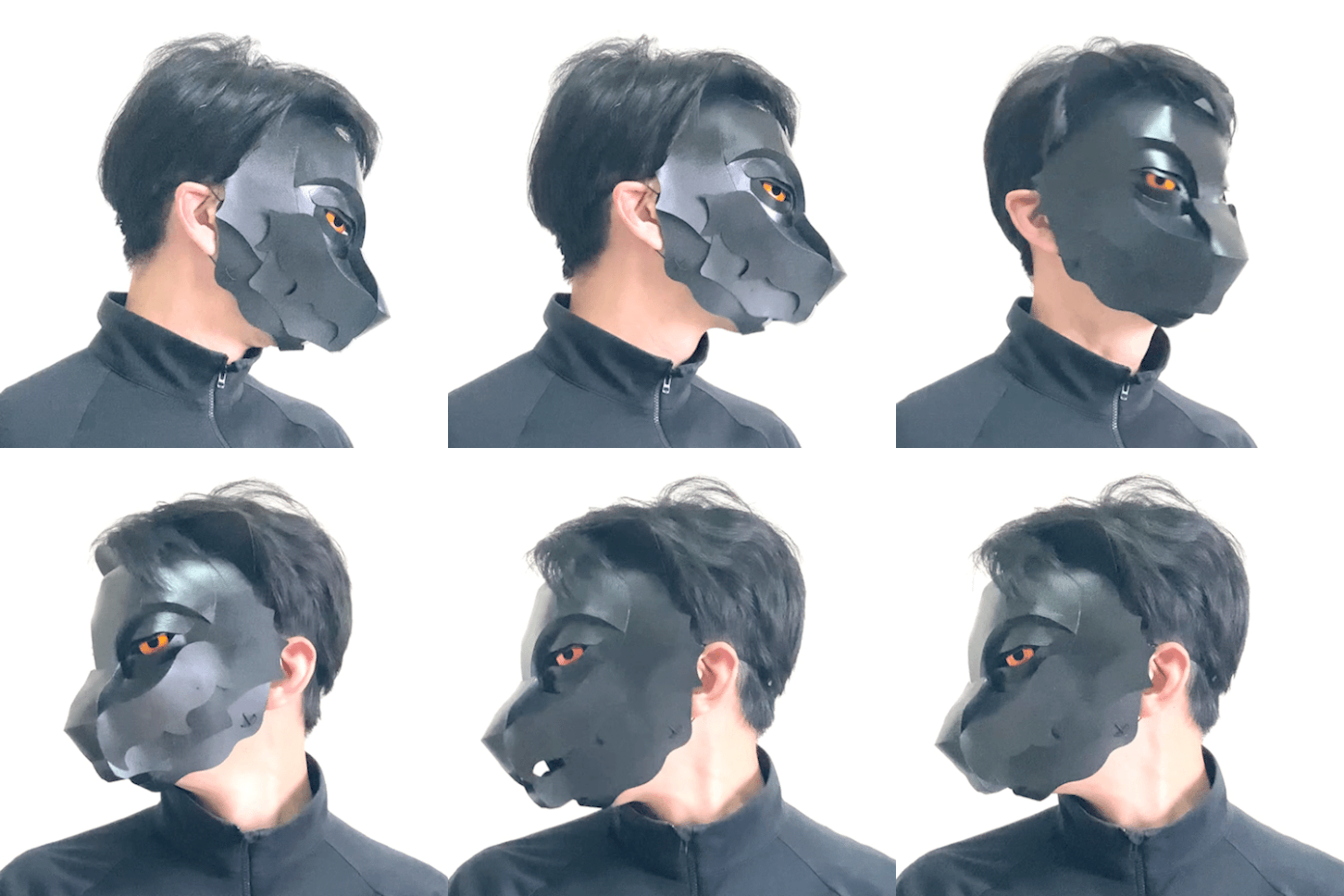
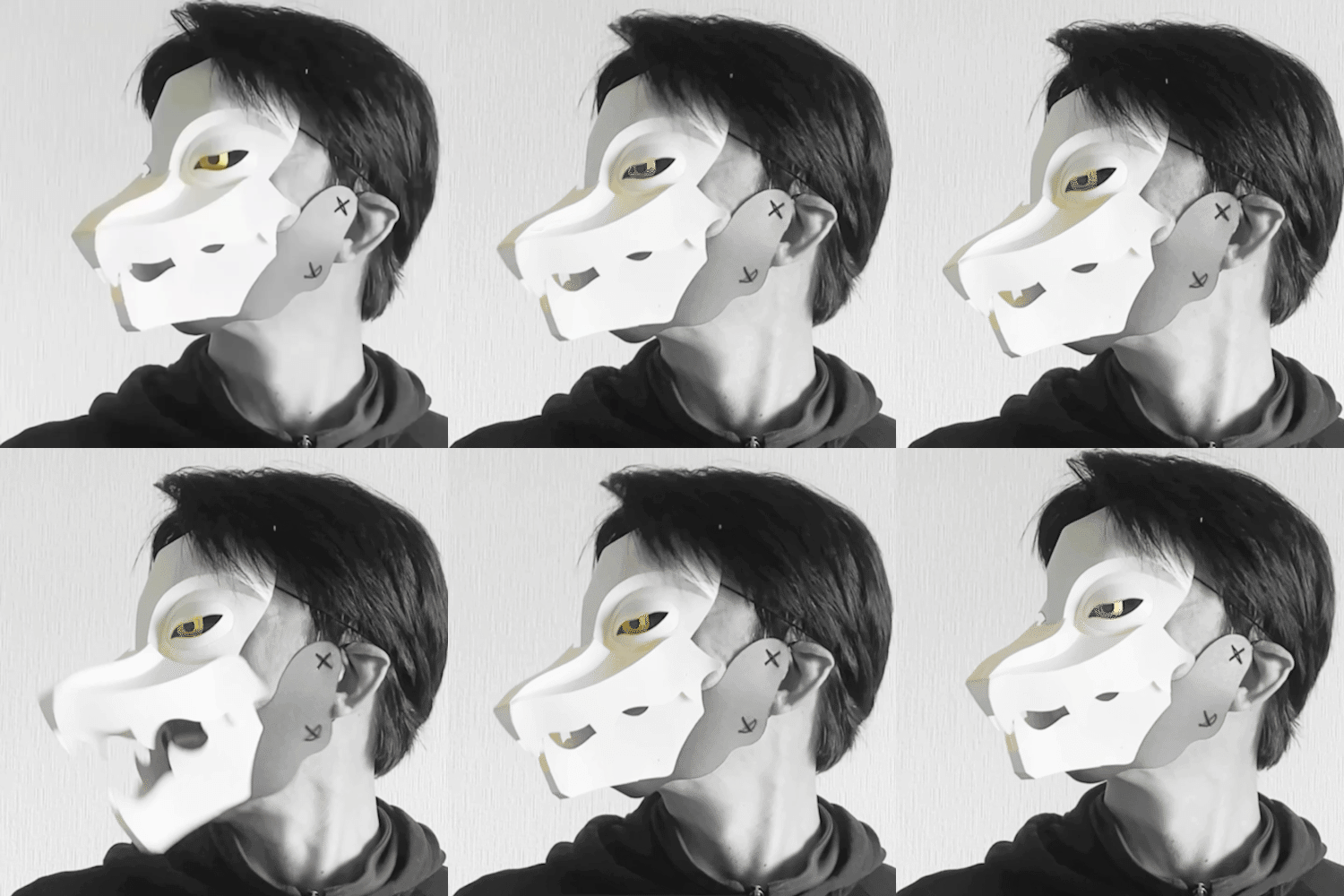
The newest material tradition is the one least indebted to historical precedent. Hayashi Takeo (林たけお, born 1965, Hokkaido), a graphic and lighting designer, uses modern high-quality paper — not washi — as the primary structural material in a curved-folding technique called kyokusen-ori (曲線折り). The paper is folded rather than molded, achieving three-dimensional form through geometry rather than layering. Some of his designs feature a jaw mechanism that moves in sync with the wearer's own jaw, transmitting movement through the paper geometry itself.
Contemporary makers also work in resin and fiberglass (FRP) for display reproductions and lightweight wearable pieces; in cast metal for decorative wall objects; and in combinations — lacquered fabric over resin forms, ceramic elements mounted on wooden structures — that exist outside any single traditional category. The most interesting contemporary work is defined not by its material but by its engagement with what Japanese mask aesthetics is actually doing: not copying a surface, but understanding the proportional logic that makes a carved face read as something more than a face.
→ Read the full guide: Make Your Own Japanese Mask: The Art of Paper Mask Craft
Masks as Sacred Objects

Photo: 東京国立博物館, Public domain, via Wikimedia Commons
In Japan, masks are rarely understood purely as theatrical props. A noh mask is stored face-up in a wooden box lined with brocade; it is handled only by the actor who will wear it, and even then with formality. The mask of okina — the divine old man of the ritual piece performed at the start of major noh programs — is kept separately from all other masks and treated as a sacred object rather than a costume element.
Festival masks likewise carry ritual weight. At Inari shrines, fox masks are not worn so much as offered — a physical form given to the spirit for the duration of the ceremony. The mask does not represent the deity; temporarily, it becomes the deity's face in the human world.
This understanding — that wearing a mask is not pretending to be something, but temporarily becoming it — is what distinguishes Japanese mask culture from most Western theatrical traditions. The actor who puts on a noh mask is taught to say not "I am wearing a mask" but "I have put on a face."
Finding Japanese Masks Today
Authentic noh masks by living masters command prices from several hundred thousand yen into the millions. Museum collections at the National Noh Theatre in Tokyo and the Kyoto National Museum hold significant holdings. For those seeking to bring a piece of this tradition home, hand-crafted festival and folk masks at a range of price points are available from specialist makers — and the growing genre of contemporary paper masks offers an accessible entry point into the craft tradition itself.
Looking for the makers themselves? We keep a directory of working Japanese mask makers and workshops, listed by lineage and prefecture: Noh mask carvers, kagura mask makers, shishi-gashira lion-head carvers, oni-shi and folk traditions, with links to their own sites.
From the Shop Floor
Everything above can be checked in a library. This part cannot. We run a physical shop in Kyojima, Tokyo, open on weekends, and every mask in it can be tried on. A few things you only learn with a mask in your hands:

- Fox masks get picked up first. Of everything on the wall, the kitsune masks are what most visitors reach for. The face is familiar from festivals and anime; the surprise is usually the weight. A habutae-bari fox mask by Komendo comes to roughly 100–110 g, about half the standard build of the same design at 200–260 g. On a shelf that is a number. On a face it is the difference between a mask you forget you are wearing and one you keep adjusting.
- Fit settles what photos cannot. A mask that looks right on a product page can sit wrong on a particular nose or brow. Trying one on decides it in seconds, which is why we encourage it, and why our product pages give the inside measurements rather than just the look.
- The shop holds more than the online store. One-off pieces by artists from Japan and abroad, traditional masks, and the That Face series share the shelves. If you are in Tokyo on a weekend, the address, hours and directions are on our About page. Photos are welcome.

Explore Our Japanese Mask Collection
KAMENYA OMOTE carries handcrafted Japanese masks and paper mask kits, spanning fox masks, realistic portrait masks, and more.


- Kitsune Fox Masks — habutae-bari and standard masks by Komendo and papercraft kits by Hayashi Takeo
- Paper Craft Mask Kits — design-your-own masks from A4 paper
- That Face – Wearable Portrait Masks — hyperrealistic human face masks
Planning a purchase? Practical guides from our shop:
- Which Japanese Mask Should You Buy? A Guide by Use
- How to Choose a Kitsune Mask: A Buyer’s Guide to Colors, Styles, and Fit
- Japanese Masks for Cosplay, Film Props, and Serious Collectors
- Hyper-Realistic Face Masks: Inside “That Face” (Anokao)
- How to Order a That Face Mask: Timeline and Common Questions
About KAMENYA OMOTE
This article was written by KAMENYA OMOTE, Japan’s only shop specializing exclusively in masks. Our physical store is in Kyojima, Sumida, Tokyo (open weekends, 13:00–18:00), and we ship worldwide to 38 countries. Our “That Face” hyper-realistic mask project has been covered by Reuters and the BBC, and we organize TOKYO MASK FESTIVAL, a mask exhibition event. See Press & Media · About the Shop · FAQ