Furyū-men · Kashima, Saga — Kamenya Omote, Tokyo

The oni that
guards the village.

For some four hundred years in southwestern Saga, dancers have put on horned oni faces and driven evil out of the village. The masks are carved by Sugicho, a wood-carving workshop in Kashima where the name Keiun has passed down five generations.

Enquire about a mask ↓

Carved to order by Sugicho · Kashima, Saga · Ships worldwide from Tokyo

A men-buryu dancer mid-leap in a black lacquered oni mask and blue shaguma mane, waist drum swinging, red spider lilies in the grass behind
Men-buryū, mid-leap — the lacquered mask, the shaguma mane and the drum at the waist. Photograph: Sugicho.

Men-buryū (面浮立) is a masked drum dance of southwestern Saga. Twenty to forty dancers — the kakeuchi — wear horned oni masks under a mane of shaguma horsehair, strap a small drum to the waist and beat it as they move, while gongs, flutes and one great drum carry the measure.

Tradition dates it to around 1530, at Tade-nawate in Kanzaki, where a hundred-odd retainers on the Ryūzōji side put on shaguma, routed a far larger army in a surprise attack, and danced afterwards still in that guise. Kashima's own account is careful here: the old records say shaguma, not masks. The masks enter the story later.

What the dance keeps is stranger than the battle. The oni fights the gods at the shrine, loses, changes heart — and then walks down into the villages as the god's messenger, carrying fortune from house to house. This is not an oni you throw beans at. It is the one you want at the door.

Men-buryū is danced as an offering — for a good harvest, for rain, at autumn shrine festivals. The Otonari and Hōgaura traditions are designated Important Intangible Folk Cultural Properties of Saga Prefecture.

The dance

Forty oni, and a drum each.

Men-buryū is danced in the open — on cut grass below the cedars in autumn, and on the gravel in front of the shrine.

Men-buryu performed on the gravel forecourt of a vermilion shrine before a crowd
Danced as an offering in the shrine forecourt. Photograph: Sugicho.

A pair, never one

A and Un.

The masks are carved female and male — the open mouth and the closed one, the first sound and the last. They are made as a pair and shown as a pair.

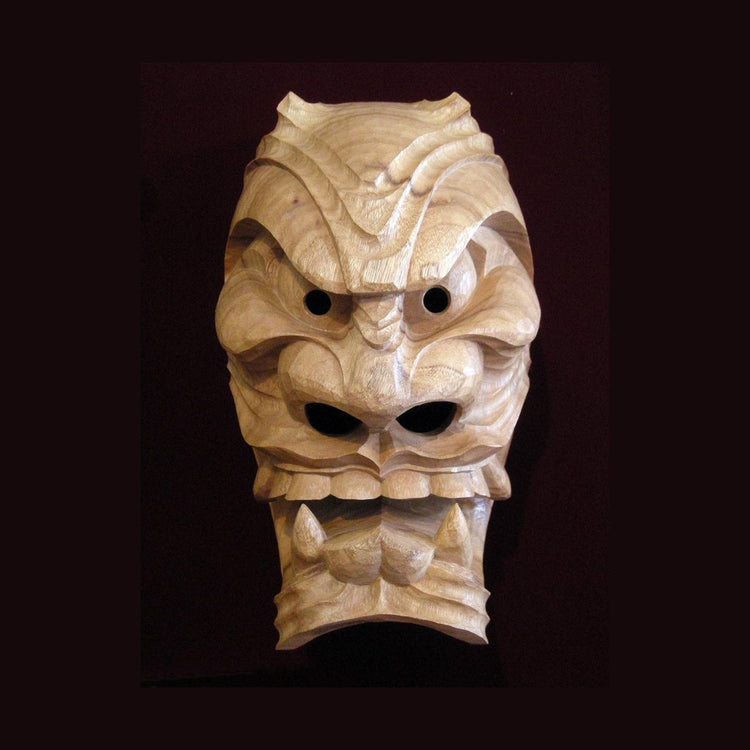
The female furyu mask in plain camphor: mouth open with fangs and tongue, upswept eyes, short horns

A — the female mask

Mouth open wide with the tongue put out. The eyes sweep upward, the furrows of the forehead stream up with them, and the horns stay short.

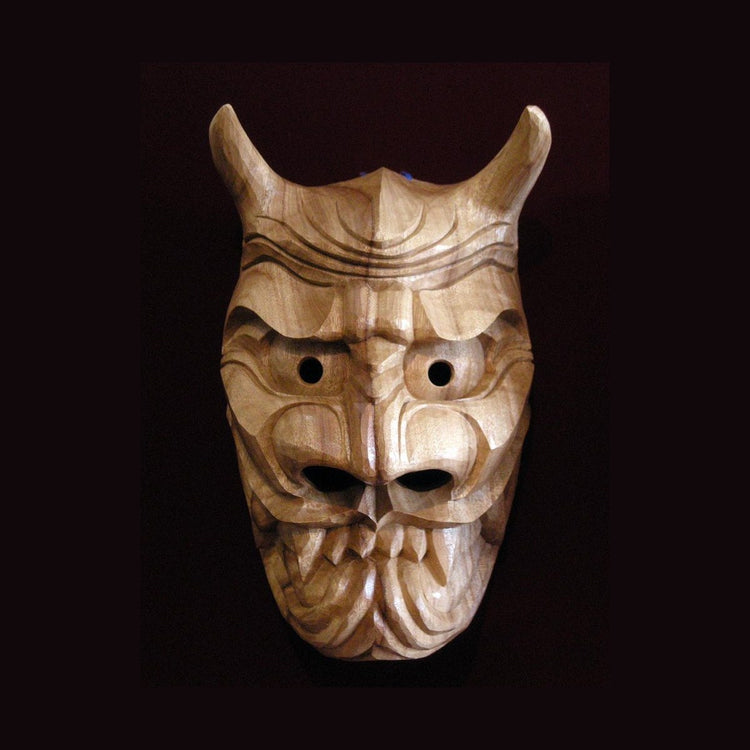
The male furyu mask in plain camphor: mouth closed, large round eyes, two long curving horns

Un — the male mask

Mouth closed and held. The eyeballs are large and round, the forehead gathers into knotted furrows, and the horns run long.

How one is made

From a standing tree to a face.

Sugicho carves the decorative masks from kusu — camphor, the tree of Saga Prefecture. The finish is cut, not sanded: over a hundred chisels, and no sandpaper anywhere in the work.

Looking up into the canopy of a large camphor tree

Camphor

Kusu, the prefectural tree of Saga — close-grained, and fragrant when cut.

Sawn camphor boards stacked to dry in the workshop

Sawn and dried

Cut into blocks and left in the workshop until the wood has stopped moving.

A camphor block with the outline of a mask drawn on it in ink

Drawn on

The outline goes straight onto the block — front and side at once.

A chisel cutting the rough form of the oni face from the camphor block, shavings around it

Cut out

The face is brought up out of the block and finished with the chisel alone.

Two finishes

One to dance in, one for the wall.

A pair of plain camphor furyu masks mounted on a live-edge cedar board with the carver's signed tag, on indigo cloth
A pair, mounted — plain camphor on a live-edge cedar board, with the carver's signed tag. Photograph: Sugicho.

Paulownia · lacquered

The dancing mask

Carved in kiri — paulownia, the wood Japan reaches for when something has to be light — and finished in lacquer. The workshop keeps these as light as it can, because they are made to be danced in. What they give up in heft they return as sheer force: this is the more imposing of the two.
Camphor · plain wood

The mask for the wall

Around Kashima the custom is to leave the lacquer off — a clear coat over bare camphor, and nothing else. Lacquer, the workshop says, makes a mask look no different from moulded plastic, and you stop being able to feel the weight of the wood. Left plain you get the grain, the smell of the camphor, and a colour that goes on deepening for years.

The workshop

Sugicho, Kashima.

Kashima sits on the Ariake Sea in southwestern Saga, and it is where men-buryū is densest — the two prefecturally designated traditions, Otonari and Hōgaura, are both from this stretch of coast.

Sugicho carves there. The carving name, Keiun, runs in the family: the fourth Keiun opened the Kashima workshop in 1975 and was certified a Saga Meister in 2002; the fifth, born in Kashima in 1981, trained under his father and has led the workshop since 2017.

Wood carving workshop Sugicho · Furueda, Kashima City, Saga. Alongside furyū-men the workshop carves helmets, nameplates, signboards and commissions.

Questions

Furyū-men FAQ

What is a furyū mask?

A furyū-men (浮立面) is the horned oni mask worn by the dancers of men-buryū, a masked drum dance of southwestern Saga. Unlike the oni of most Japanese folklore, this one is protective: in the dance it is defeated by the gods, changes heart, and goes down to the villages as the god's messenger to bring good fortune.

Why are they sold as a pair?

Furyū-men are carved as a female and male pair — a and un, the open mouth and the closed one. The female mask has an open mouth with the tongue out, upswept eyes and short horns; the male has a closed mouth, large round eyes and long horns. They are traditionally displayed together, though a single mask can be commissioned.

What are they made of?

Two traditions run in parallel. Masks made to be danced in are carved from paulownia and lacquered, and kept as light as possible so they can be worn. Masks made as decorative pieces are carved from camphor — the tree of Saga Prefecture — and take a clear coat only, no lacquer, which is the custom around Kashima: lacquer hides the weight of the wood. Plain camphor keeps its grain and its scent, and darkens gradually with the years.

How long does one take?

Each mask is carved to order at the workshop, and the maker asks for one to three months. Pieces already finished and in stock can ship sooner. Everything is sent from Tokyo with tracking once it reaches us.

Order

Carved when you order.

Each mask is cut to order at the workshop — allow one to three months before it ships from Tokyo.

The "un" furyu mask in plain camphor: mouth closed, large round eyes, two long curving horns

Furyu Mask "Un" (Male Oni)

$1,864.50 USD · free worldwide shipping

The "a" furyu mask in plain camphor: mouth open with fangs and tongue, upswept eyes, short horns

Furyu Mask "A" (Female Oni)

$1,864.50 USD · free worldwide shipping

Carved in Kashima. Shipped from Tokyo.

Furyū-men are made to order, and Sugicho also takes commissions for masks of your own design. Tell us what you are looking for — a pair, a single mask, plain wood or lacquered — and we will come back with a price and a date.

Contact Kamenya Omote →

Curious how the oni became both demon and guardian? Read our guide: The Oni Mask in Japanese Culture.